- Office Partitions
- AlphaGlass Railing
How Glass Office Partitions Can Transform Your Workspace
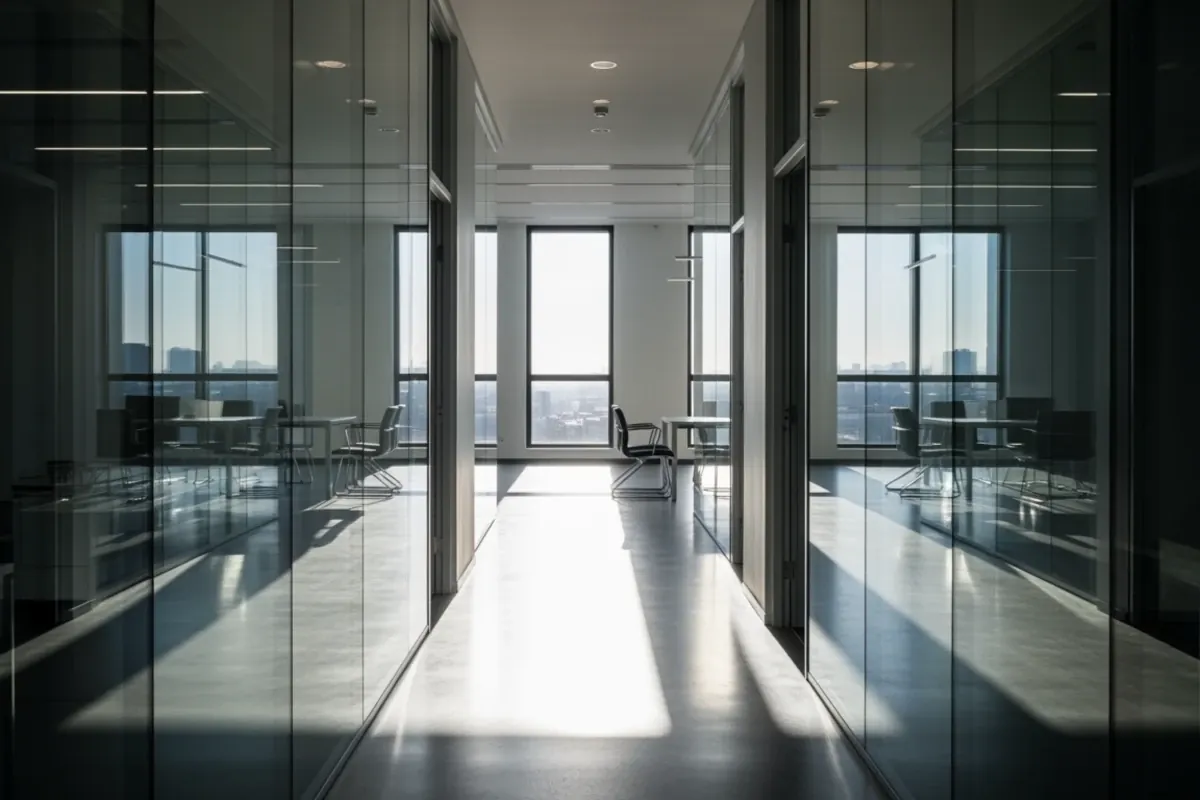
Table of Content
Walk into an older office with solid drywall everywhere and you feel it right away. The rooms are separated, but so is the light. Meetings happen behind closed doors. Corridors feel narrower than they really are. In a place like Vancouver, where grey days are common for a big part of the year, that matters more than people admit.
Glass office partitions change that mood fast. They divide space without making it feel sealed off. They can give teams privacy, create quiet zones, improve circulation, and still let daylight move through the office. That mix is why so many businesses are rethinking the way they build interiors.
The useful part is this: glass is not one thing. Office glass partitions come in several forms, and the right choice depends on how your team works, how much noise control you need, and how permanent you want the layout to be.
Why businesses are moving away from solid walls
A lot of offices were built around a simple assumption: if you need separation, you build a wall. That works, but it comes with tradeoffs. Permanent walls block views, cut off natural light, and make reconfiguration expensive. If your team grows, shrinks, or changes the way it uses space, those walls start to feel stubborn.
Glass partition walls solve a different problem than drywall. They still define rooms, but they do it with less visual weight. That makes a floor plan feel more open, even when the square footage has not changed at all.
This matters for a few reasons.
First, people tend to prefer workplaces that feel bright and connected. Second, managers often want a layout that supports focus without making the office feel chopped into boxes. Third, many businesses are trying to get more use out of the same footprint instead of moving to a larger space.
Office partitions made from glass sit right in the middle of those needs. They can carve out meeting rooms, private offices, reception areas, touchdown spaces, and small call rooms, while keeping the whole office from feeling darker and tighter.
What glass partitions actually change in day-to-day work
The visual difference is obvious. The operational difference is where things get interesting.
A well-planned partition system changes how people move through the office, where noise collects, and how easy it is to switch between collaboration and concentration. It can also make an office feel more intentional. That sounds a little abstract, but you notice it in real ways: fewer awkward empty corners, better use of perimeter light, and rooms that feel connected to the rest of the workplace instead of buried inside it.
Here’s what tends to improve most:
Natural light distribution
This is usually the first reason people look at office glass partitions. If your office has windows along one side, solid internal walls often trap daylight at the perimeter. Glass allows that light to travel deeper into the space.
In the Lower Mainland, where daylight can feel scarce during winter months, that’s not a small upgrade. Brighter interiors tend to feel more comfortable and less closed in. You may still need artificial lighting, of course, but the whole office feels less dependent on it during the day.
A better sense of space
Even smaller offices can feel bigger with glass partition walls. The square footage stays the same, but sightlines stay open. You can separate functions without creating a maze.
This is especially helpful in offices that need both private rooms and shared work areas. Traditional construction often makes that balance harder than it needs to be.
More flexible planning
Many partition systems are easier to adapt than permanent walls. Some are demountable, which means they can be reconfigured later if the office changes. If your headcount is likely to shift, or you expect to repurpose rooms over time, that flexibility matters.
I think this is one of the most practical reasons to choose glass. The nice look gets attention, but the ability to change a space without starting from scratch is what saves headaches later.
Choosing the right type of office glass partition
Not every system works the same way, and this is where projects usually get more specific.
Frameless glass partitions
Frameless glass partitions have a clean, minimal look. They rely on as little visible hardware as possible, so the glass itself becomes the main feature. If you want the office to feel open, modern, and visually light, this style is hard to beat.
They work well for conference rooms, executive offices, and open-plan divisions where aesthetics matter. The tradeoff is that fully frameless systems are not always the best answer when maximum acoustic control is the priority. They can still perform well, but the detailing matters a lot.
Aluminum framed partitions
Aluminum framed partitions add more visible structure around the glass. Some businesses prefer this look because it feels more defined and architectural. Black frames are especially popular when a space wants stronger lines and a bit more contrast.
Framed systems can also help with durability and performance, depending on the design. If the office uses rooms heavily throughout the day, or wants a clearer visual distinction between spaces, aluminum framed partitions often make sense.
Double-glazed partitions
Double-glazed partitions use two panes of glass with a gap between them. This setup helps with sound control and gives the partition a more substantial feel. For offices with frequent meetings, confidential conversations, or hybrid work patterns where people jump between calls and desk work, double-glazed partitions are often worth a serious look.
They usually cost more than single-glazed systems, but the improvement in acoustic performance can justify that cost quickly if noise is a real issue.
Acoustic glass
Acoustic glass is designed to reduce sound transmission better than standard glazing. This matters in law offices, accounting firms, clinics, HR departments, boardrooms, and any workplace where speech privacy counts.
One mistake people make is assuming all glass walls are noisy by default. Poorly specified systems can be. Well-designed systems with acoustic glass, proper seals, and the right door details can perform much better than many people expect.
Privacy does not have to mean closing everything off
This is where some businesses hesitate. They like the openness of glass, but they worry that everyone will feel too exposed.
That concern is reasonable. The good news is that privacy has options now, and they do not all involve frosting every panel.
Frosted, tinted, and patterned finishes
Partial frosting can block sightlines at seated height while keeping the upper portion clear. That works well in meeting rooms and private offices. Tinted glass can soften visibility too, though it changes the look of the room more noticeably.
Patterned film is another approach if branding or visual distinction matters, but even simple bands of frosting can do a lot.
Smart film for privacy on demand
Smart film is one of the more interesting solutions because it changes from clear to opaque when activated. In plain terms, you get openness when you want it and privacy when you need it.
This can be useful in boardrooms, clinic consultation rooms, HR spaces, or any area where the use changes throughout the day. A room can feel open and connected most of the time, then turn private for a meeting in seconds.
I like this option when a business hates the idea of permanent visual blockage but still needs control. It is not necessary for every office, but in the right setting it solves a very real tension.
Doors matter more than people think
A partition is only as functional as the way people move through it. Door style affects traffic flow, privacy, sound, and how much usable floor area you keep.
Sliding systems for tight layouts
A partition sliding door can be a smart choice when space is limited. Because it does not swing into the room, it preserves floor area and can make smaller offices or meeting rooms easier to use.
This can help in narrow corridors, compact private offices, or rooms where furniture placement is tight. The main question is acoustic performance. Sliding systems usually need careful detailing if sound control matters.
Swing doors and glass patch doors
Glass patch doors are common in modern partition systems. They use minimal hardware, keep the look clean, and pair nicely with frameless glass partitions. They are popular in offices that want a polished, simple appearance.
Standard swing doors can also work very well, especially when you need stronger seals for acoustic performance. This is one of those choices where the most attractive option is not always the best operational option. If a room hosts confidential meetings all day, the door should be chosen for performance first, appearance second.
Where glass partitions work best inside an office
Some of the best uses are obvious: conference rooms, private offices, and reception enclosures. But there are other good applications that often get overlooked.
Glass office partitions can help create:
- Focus rooms for phone calls or heads-down work
- Team spaces that stay visually connected to the rest of the office
- Waiting areas that feel defined without feeling boxed in
- Breakout zones for quick meetings
- Quiet rooms for HR or wellness use
The point is not to turn the entire office into glass. That can feel cold if overdone. The goal is to place separation where it improves function while keeping the office open where openness helps.
That balance matters. Too little separation and the office gets noisy and distracting. Too much and it starts to feel rigid again.
What to think through before installation
This is usually the stage where a good idea becomes either a good project or an annoying one. Before choosing materials or finishes, it helps to answer a few practical questions.
- What kind of privacy do you actually need? Visual privacy, acoustic privacy, or both?
- Which rooms will be used for meetings, calls, or confidential work?
- How much natural light are you trying to preserve?
- Will the office layout need to change in two or three years?
- Are there areas where a sliding door will save space?
- Does the building have sound expectations or code requirements for certain rooms?
Those questions help narrow the system quickly. For example, if the goal is mostly light and visual separation, single-glazed glass partition walls may be enough. If people need quiet for frequent calls, double-glazed partitions or acoustic glass may be the better direction.
Common mistakes to avoid
The biggest mistake is choosing only on appearance. Glass can look great in almost any form, so it is easy to focus on style and forget performance.
Another common miss is underestimating sound. Many businesses say they want openness, then realize after installation that they also wanted stronger speech privacy. That is why it helps to decide early whether a room is mostly for casual use or for concentrated, confidential work.
Door selection is another area where projects go sideways. A beautiful system with the wrong door can feel awkward every single day. Think about clearance, swing direction, traffic flow, and seals.
Finally, do not ignore maintenance and hardware quality. Glass itself is relatively easy to care for, but cheap hardware ages badly. Handles loosen, tracks collect dirt, and doors go out of alignment. A partition system gets used constantly, so the details matter.
Maintenance is simpler than most people expect
People sometimes worry that office glass partitions will be hard to keep clean. In practice, they are usually straightforward. Regular glass cleaning, attention to fingerprints around handles, and periodic checks on hardware go a long way.
Frameless systems show smudges more easily, especially in high-touch areas. That is the price of a cleaner visual look. Framed systems can hide some wear better, but they still benefit from routine cleaning and occasional adjustment.
If you choose smart film, there is more to think about because it includes an electrical component, but daily use is still simple once installed properly.
Are glass partitions right for every office?
No, and that is worth saying plainly.
If a workplace needs maximum isolation, heavy-duty security, or full visual separation everywhere, traditional walls may still be the better fit in some areas. Glass is strong and versatile, but it is not a magic answer for every room.
What it does well is help offices balance openness and division. It works especially well for businesses that want more daylight, a cleaner layout, and better use of existing square footage without making the office feel shut down.
That is why office partitions made from glass have become such a practical option. They improve how a space looks, yes, but more importantly, they improve how it functions. People can see more, move better, and still find privacy where it counts.
For many workplaces, that is the real transformation. Not something dramatic. Something better used, better lit, and easier to work in every day.

Explore limitless glass interior designs for bright, high-quality spaces with soundproof office partitions for serene workplaces